
As we enter a pivotal new phase of our global research efforts, we are excited to share the next era of GP2 for 2026–2029. In addition to our existing genetic discovery efforts, we are expanding GP2’s scope to bridge the gap between ancestry-informed genomics and its functional role in Parkinson’s disease (PD). In doing so, we are widening the scope of GP2 beyond genetics to incorporate collection and analysis of additional biosamples, including plasma, CSF, urine, and brain tissue.
Currently, PD is understood as a multifactorial condition driven by a complex interaction between genomic susceptibility and environmental triggers. For this reason, GP2’s focus is expanding from its foundation in genetics to investigate how downstream biological pathways interact with individuals’ genetic landscape to influence disease onset and progression. This strategic roadmap represents a unified commitment to transforming biological data into scientific discoveries with real-world impact. This period serves as the ultimate testing ground to prove that molecularly defined data can de-risk the path to a cure.
Below, we provide a high-level summary of the four pillars that will define our collaborative work and drive our mission toward personalized PD treatments over the coming years.
GP2 Strategic Roadmap
The new GP2 strategic roadmap is divided into four key pillars aimed at advancing the global understanding of PD through 2029.
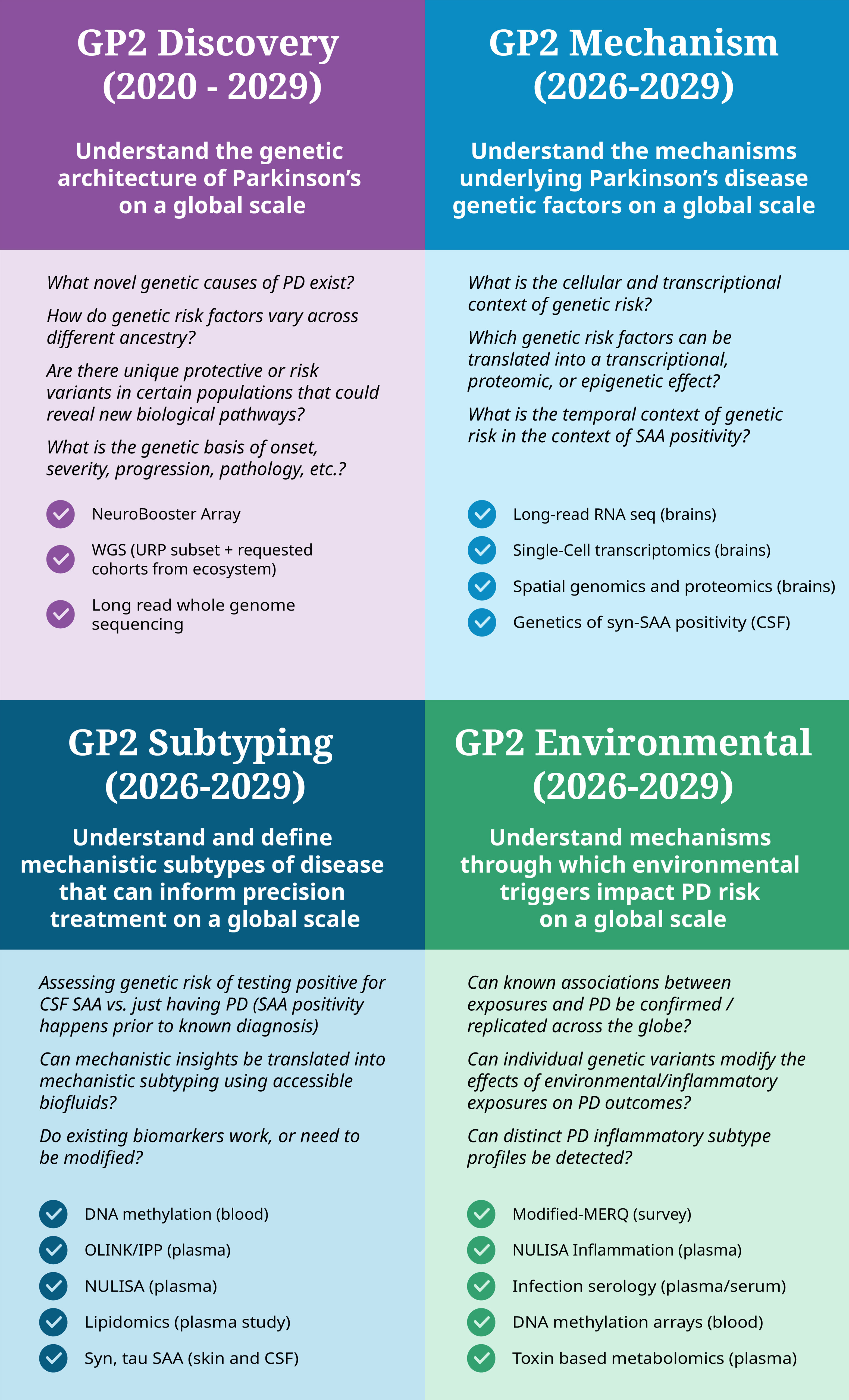
- The Discovery effort focuses on uncovering the genetic architecture of PD across diverse ancestries. This has been our core mission since 2020 and will continue as a key initiative moving forward.
- The Mechanism effort investigates the cellular and transcriptional contexts of these genetic risks. This workstream will use biosamples, including brain tissue from regions of interest and a combination of transcriptomics, proteomics, and sequencing methodologies to transform novel GWAS loci hits into viable biological hypotheses for cell biologists to test.
- The Subtyping effort seeks to define mechanistic disease subtypes using biomarkers such as proteomics and lipidomics to inform translational medicine.
- The Environmental effort explores how external triggers and inflammatory exposures interact with underlying genetic architecture to impact PD risk on a global scale, utilizing surveys and toxin-based metabolomics.
Together, these pillars represent a multimodal approach that leverages the foundation of GP2’s established infrastructure and global partnerships.
This roadmap is an invitation for our global community to contribute to a deeper understanding of the disease. By aligning our discovery efforts with mechanistic subtyping and environmental exposure data, we are positioning GP2 to deliver insights that were previously out of reach. Each cohort’s unique dataset is essential to filling geographic gaps and providing statistical power to reach GP2 key milestones, and we appreciate their continued contributions toward GP2’s vision. Together, we are ensuring that the future of PD research is globally representative and clinically transformative.