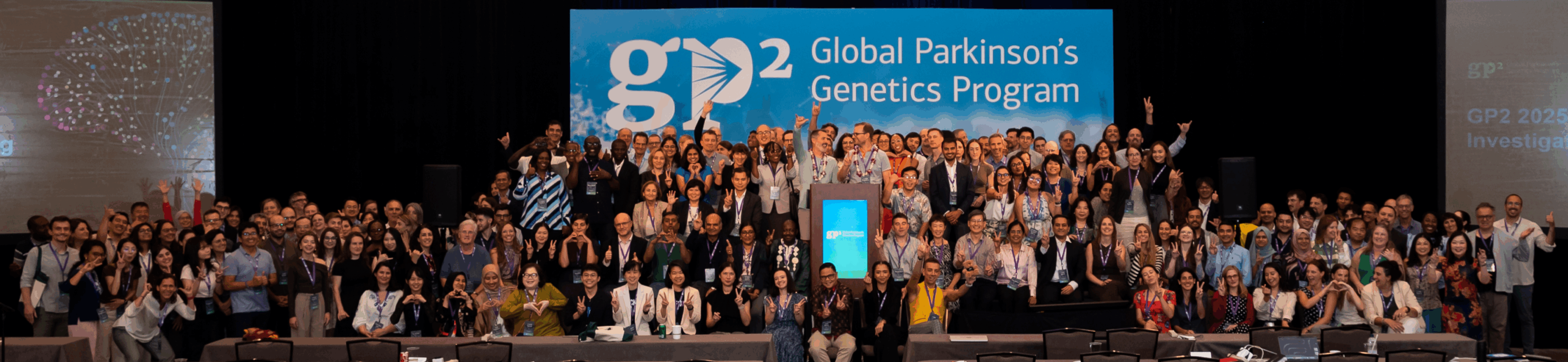

In October, over 230 investigators from 52 countries across the globe convened in Honolulu, Hawaii, for the Global Parkinson’s Genetics Program (GP2) 5th Annual Investigators Meeting (AIM). Despite the call of the sun and waves, energy bubbled in the conference hall. Conversations revealed themes of building community, reflecting on the impressive progress of the last six years, and pathways forward.
Excitement was palpable. Since GP2’s first genome-wide association study in 2023, which introduced a novel risk variant in Western African populations, the number of GP2-affiliated research outputs has been increasing at a rapid pace, with over 40 GP2 articles now available GP2’s 10th Data Release in July of this year brought the number of samples genotyped up to 92,021. Each successive update brings GP2 a step closer to its goal to genotype 250,000 individuals around the world. GP2 AIM 2025 brought an opportunity to look back on how far we’ve come and what remains to be accomplished toward this goal.

Over the course of two days, attendees heard presentations from over 35 colleagues, including 15 trainees, and browsed 44 poster presentations. Three key themes emerged across sessions:
- Findings Across Global Genetic Studies: Attendees learned about new results from five population-specific genome-wide association studies (GWAS) which were completed in the last year in African, European, Latin American, South Asian, and sex-stratified populations. Some of the countries involved in the presented studies had never before collected Parkinson’s disease genetic data, highlighting the tangible impact that GP2 has had on Parkinson’s research. In Kyrgyzstan, for example, attendees learned that GP2 enabled the training of 30 neurologists, the establishment of a PD registry, and the development of the first biobank in the country.
- Access to Data: GP2 introduced a new standardized data release and return schedule, along with updated documentation, to enhance data readability. Attendees also learned about five new data browsers, including the new GP2 genome browser developed in collaboration with the Broad Institute, which were developed to provide easier navigation of collective results.
- Career Development: The GP2 Trainee Network provided an overview of opportunities for career development, such as the train-the-trainer workshop model, which aims to enable the transfer of laboratory, bioinformatics, and mentorship skills to build local capacity in Latin America, Africa, Asia, and Eastern Europe.
Together, these sessions set the stage for the meeting’s milestone announcement: GP2 has now genotyped 100,000 samples, one third of which were volunteered by underrepresented global populations. At the start of GP2 in 2020, the goal of 250,000 samples felt nearly impossible to some. Yet, GP2’s achievements to date have demonstrated that seemingly insurmountable tasks can be accomplished through worldwide collaboration, skill sharing, and capacity building.

Where does GP2 go from here?
Overall, GP2 AIM 2025 reunited old friends and colleagues, fostered new connections, and affirmed a collective commitment to global participation in Parkinson’s research. Invigorated by accomplishments to date, investigators are now looking at a goal of 350,000 samples by 2030. The impressive research outcomes of the last six years have motivated GP2 to expand its focus for the coming years to include functional genomics, which will help researchers and clinicians better understand disease subtypes and underlying mechanisms in a global context. Even in the middle of the Pacific, thousands of miles from home, GP2 AIM 2025 reminded researchers that despite their distance, they are united in pursuit of more effective, equitable, and accessible Parkinson’s treatment around the world.